

 April 19, 2026
Paintless Dent Repair
Explained. When It Works
and When It Fails
Last updated: 19 April 2026. Reading time: 12 minutes.
The repair method most Indian owners have only half understood
Paintless dent repair has quietly become the gold standard for minor dent work on premium cars across the world. Every BMW dealer, every Mercedes body shop, every Porsche authorised workshop in Europe offers PDR first and traditional repair only when PDR is not viable. Insurance companies in the US and UK now default to PDR for hail damage claims because the results are better and the costs are lower.
In India the conversation is less mature. Most owners have heard the acronym PDR, have seen a 30 second Instagram reel of someone popping a dent with what looks like a metal rod, and have a vague sense that PDR is cheaper than full panel work. Beyond that the knowledge gap is large. Which dents actually qualify. What separates a real PDR technician from someone with basic tools. Why some studios can fix a dent in 30 minutes that another studio insisted needed full panel repaint. Why luxury car manufacturers have their own approved PDR specifications. What happens when PDR is attempted on the wrong dent.
This blog is the full explainer. Not a sales page. The real technical picture, the real limitations, the real economics for a Lucknow premium car owner. By the end you will be able to evaluate any PDR claim any studio makes and know whether it is credible.
1. What paintless dent repair actually is
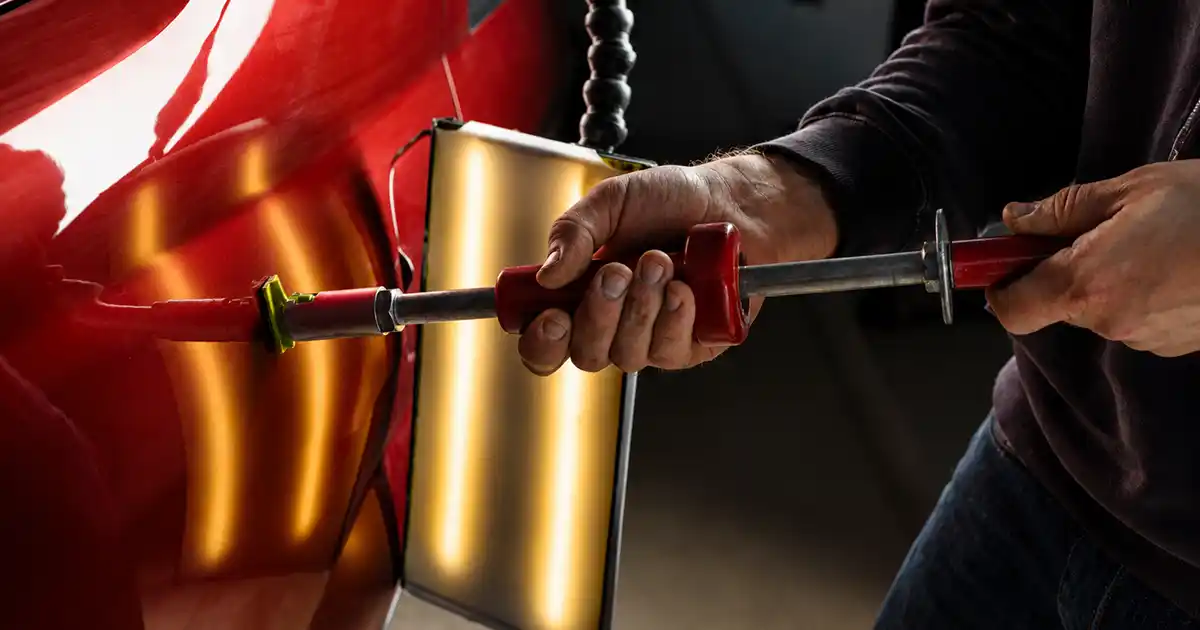
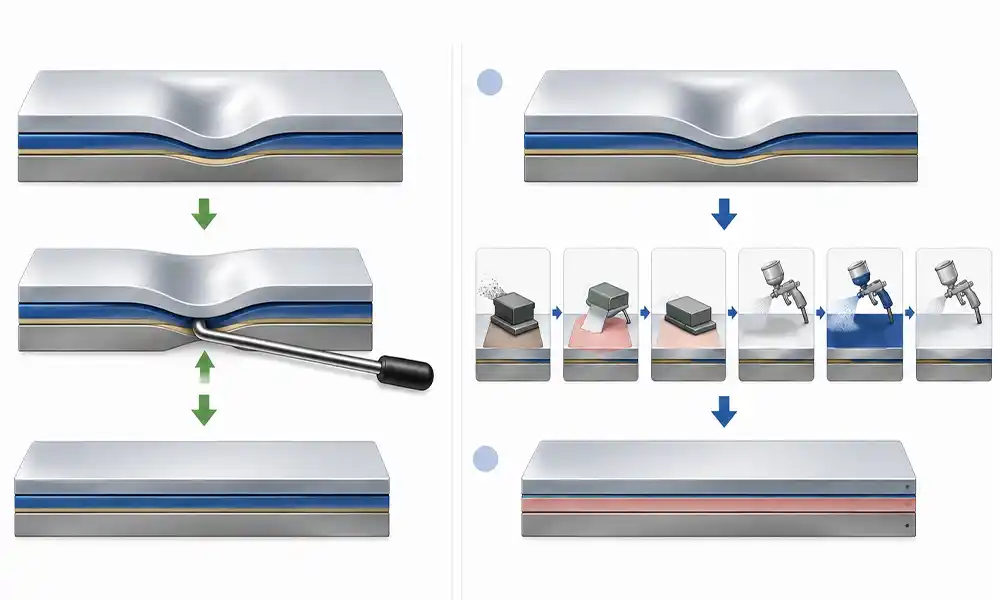
Paintless dent repair is a technique where a trained technician restores a dented panel to its original shape by applying controlled pressure from behind the panel or by pulling the dent outward from the front using specialised glue tabs and pullers. No sanding. No body filler. No primer. No paint. No clear coat. The factory paint stays completely intact.
This is the fundamental difference from traditional dent repair. Traditional repair strips the paint, works the metal, fills any low spots with body filler, sands the filler smooth, primes, paints, and clear coats. Traditional repair is a paint job with metal work underneath. PDR is metal work only.
The reason PDR matters. Your car's factory paint is applied under conditions no body shop can replicate. Factory paint is electrocoated onto bare metal, baked at high temperatures, and cured in controlled environments. No subsequent paint job ever matches factory paint for adhesion, UV resistance, and long term durability. PDR preserves this factory finish. Traditional repair replaces it with shop paint, which is good but never factory good.
For minor dents where PDR is feasible, the choice between PDR and traditional repair is not close. PDR wins on cost, wins on time, wins on preservation of factory finish, and wins on resale value. The only question is whether the specific dent qualifies.
2. The 7 specialist tools behind a real PDR repair
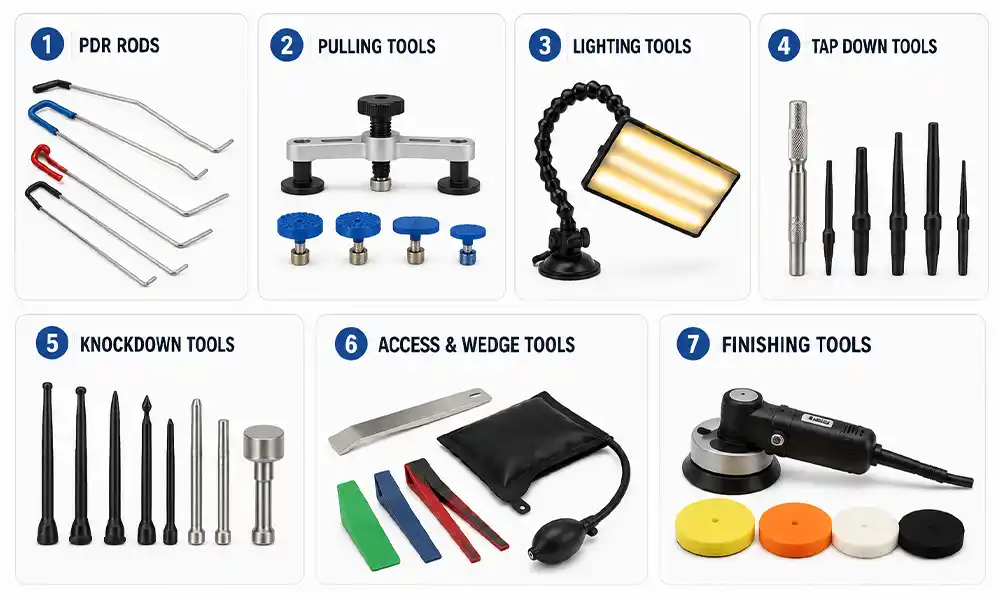
A technician with just a suction cup and a hammer is not doing paintless dent repair. They are doing something that looks like PDR on video. Real PDR uses 7 categories of specialist tools, and the presence of these tools is one of the clearest indicators of a genuine PDR capable studio.
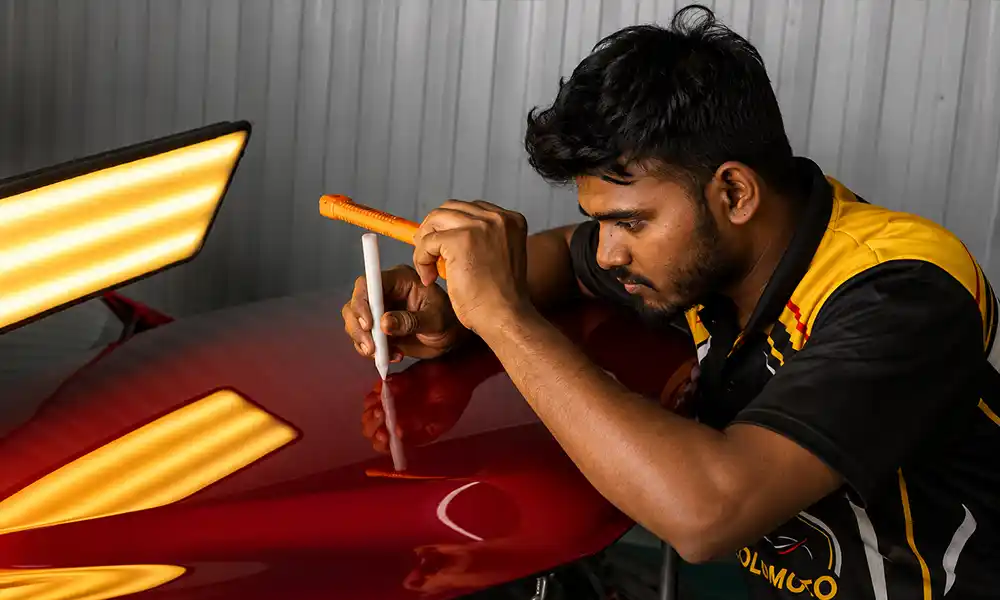
Tool category 1. Reflection boards
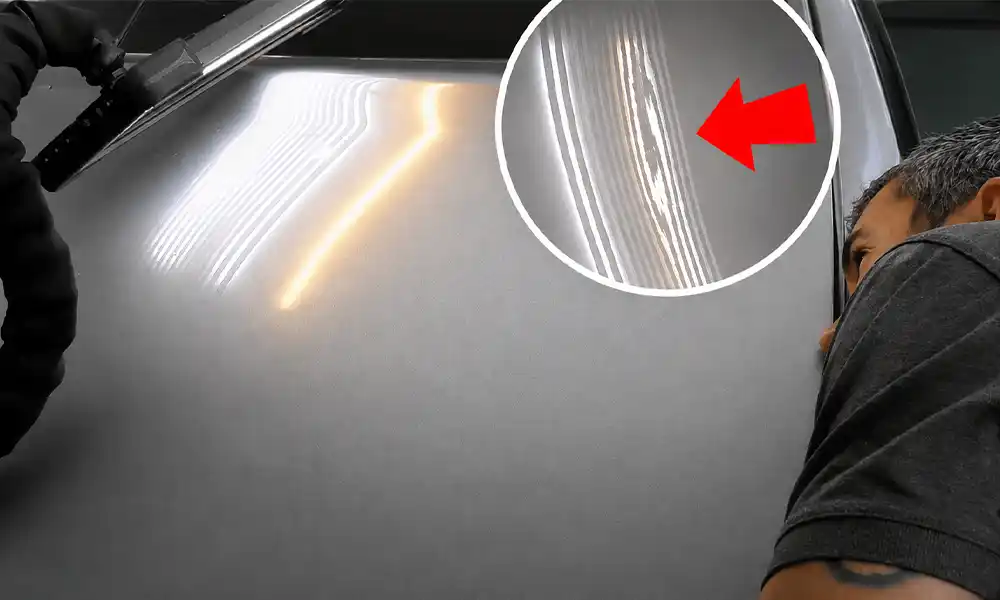
A striped black and white board positioned to reflect off the dented panel. The distortion in the reflection tells the technician exactly where the dent boundaries are, where the high spots are, and where pressure needs to be applied. Reading a reflection board is the single most important PDR skill. A technician who cannot read the board accurately cannot deliver a clean repair no matter how expensive the rest of the tools are.
Tool category 2. PDR rods
Steel rods of varying lengths and tip shapes used to push the dent from behind the panel. A professional PDR studio has 40 to 80 rods in different lengths, angles, and tip shapes. Different dent locations need different rod geometries to reach the back of the panel without touching adjacent structural parts.
Tool category 3. Glue pulling system
For dents where the technician cannot reach behind the panel, glue pulling is the alternative. Hot glue is applied to a plastic tab, the tab is stuck to the centre of the dent, and a slide hammer or bridge puller pulls the tab outward to raise the dent. Professional glue pulling uses specific glue formulations that do not damage the paint on removal. Generic hot glue sold in hardware stores is not the same thing.
Tool category 4. LED PDR lighting
Specific LED lights with focused beam patterns that highlight dent contours. Normal workshop lighting is useless for PDR because it flattens the shadow lines that reveal dent depth. A proper PDR studio has multiple adjustable LED lights positioned to cast the right shadow angle for each dent location.
Tool category 5. Tap down hammers
After pushing a dent up, the technician sometimes needs to tap down small high spots that rise slightly above the surrounding panel. Tap down hammers are small precision hammers with specific tip materials that do not scuff paint. These are how a good PDR technician achieves a finish that is genuinely level with the original panel rather than slightly bulged.
Tool category 6. Knockdowns and blending tools
Specialised tools for smoothing the transition between a PDR repair area and the surrounding undamaged panel. Proper blending is what takes a PDR repair from visible up close to invisible even under reflection. Blending tools are a significant investment for a studio and are rare in low cost PDR operations.
Tool category 7. Vehicle access tools
Every PDR job requires the technician to reach behind the panel. Different panels have different access routes. Professional studios have dozens of purpose built access tools. Door panel wedges for working through the window glass gap. Fender access clips. Bonnet support brackets. Without proper access tools, a technician either cannot reach the dent or risks damaging internal structural parts getting there.
The total investment in a proper PDR tool set runs into multiple lakhs for a premium studio. This is why real PDR is not offered by every garage that claims it. The tools alone separate studios that do PDR from studios that just use the word.
3. How a qualified PDR technician approaches a dent
The process is worth understanding because it reveals what a real PDR repair looks like versus what an amateur one looks like.
Step 1. Assessment
The technician examines the dent under multiple light angles using the reflection board. They classify the dent by depth, by crease presence, by accessibility, and by material. They test the paint integrity with careful pressure to confirm there is no hidden crack. This step alone can take 10 to 15 minutes on a complex dent.
Step 2. Access planning
The technician identifies how to reach the back of the panel without removing trim unnecessarily. A skilled PDR technician uses the smallest possible access route. An unskilled one removes trim that does not need removing, which creates its own risk of paint scuffs during reassembly.
Step 3. Initial push
With the rod positioned against the centre of the dent from behind, the technician applies slow graduated pressure. The dent does not pop out all at once. It rises in small stages over multiple pressure applications. Each stage is assessed against the reflection board before the next push.
Step 4. Sequence the repair
Larger dents are worked from the outside edges inward, then from the bottom up. The sequence matters because working the centre first traps the surrounding dent shape. Working from the edges first releases the surrounding metal first.
Step 5. Blend the transition
Once the dent is level with the panel, the technician works the transition zone around the repair area to eliminate any subtle rise or dip. This is the stage most amateur PDR attempts skip, which is why amateur PDR often leaves a visible halo around the repair site.
Step 6. Final reflection check
The technician walks around the panel with the reflection board at 3 different angles to confirm no residual distortion. If a distortion is visible, the repair is not finished.
Step 7. Paint inspection
Because PDR works the metal under the paint, the technician checks the paint one more time for any stress cracks that may have appeared during the repair. If a crack is found, the client is informed and a touch up or panel repaint is recommended.
A complete PDR on a qualifying dent takes 30 minutes to 2 hours depending on the complexity. A rushed repair that takes 15 minutes is usually skipping steps 4, 5, or 6, which is why the repair looks fine at handover and visible a month later.
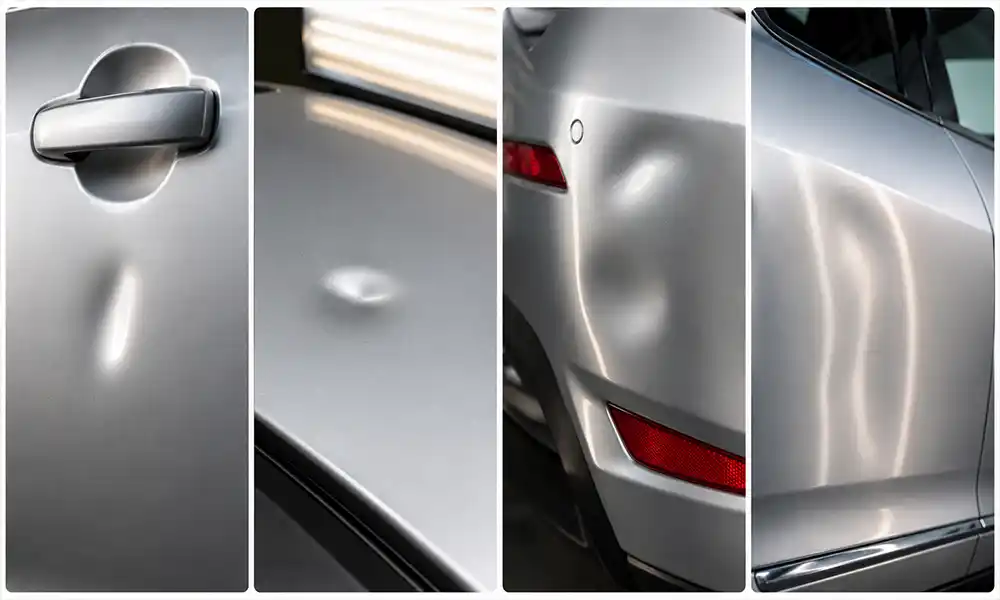
4. The 4 dent categories where PDR works beautifully
PDR excels on these 4 specific dent categories. If your dent falls into any of these, PDR is almost certainly the right repair method.
Category 1. Shopping trolley and parking dings
Shallow dents 2 to 5 cm across with intact paint, on flat sections of doors or fenders. These are the easiest PDR repairs. Typically 30 to 45 minutes. Restoration is invisible. This is where PDR earns its reputation.
Category 2. Hail damage
Multiple small dents across the bonnet, roof, and boot from hailstorms. PDR is the global insurance industry standard for hail because any one panel might have 20 to 40 small dents, and repainting every affected panel would be ruinously expensive. A skilled PDR technician works through the dents one by one using a combination of rod pushing and glue pulling.
Category 3. Shallow door impact dents
A shopping trolley collision at higher speed or a moderate door swing into your car can produce a 6 to 10 cm dent that still has intact paint. As long as the metal is not sharply creased, PDR can handle these. Repair time 60 to 90 minutes.
Category 4. Light hail or falling small object dents
A cricket ball on the bonnet. A small fruit falling from a tree. A pebble flicked up by another vehicle onto a parked bonnet. These produce shallow round dents that are ideal PDR candidates.
The common pattern across all 4 categories. Shallow dents, smooth curves, intact paint, accessible panels. When all 4 apply, PDR delivers a repair that preserves factory paint and costs a fraction of traditional repair.
5. The 6 situations where even premium PDR cannot work
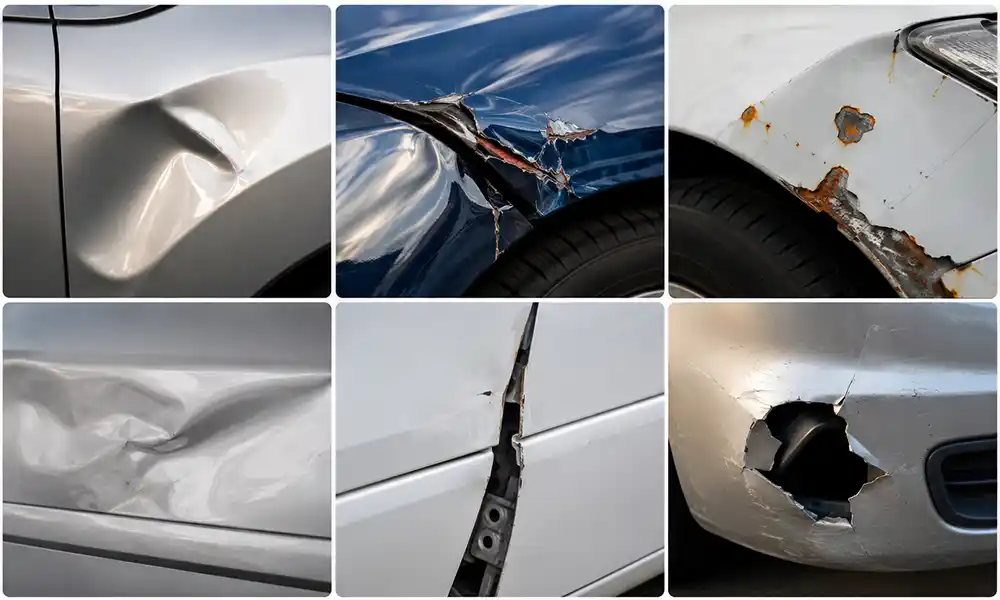
This is the section most PDR marketing skips. These 6 situations are where honest PDR studios say no, and dishonest ones attempt PDR anyway and make the damage worse.
Situation 1. Any paint damage
If the paint is cracked, chipped, or missing, PDR cannot fix it. PDR works the metal under the paint. If the paint is damaged, metal work is necessary but paint work is also necessary. The correct repair is traditional repair or a hybrid approach where PDR corrects the metal first and then a small area is repainted.
Situation 2. Sharp creases and folds
A dent with a visible crease or fold line means the metal has been stretched beyond its elastic memory. No amount of rod pushing will restore a stretched panel to its original shape. These require traditional repair with metal pulling, body filler, and repaint.
Situation 3. Dents on panel edges or body lines
The raised character lines along modern cars, the edges where panels meet, corners of panels near lights. These locations have complex geometry that rod access cannot reach cleanly. Even the best PDR technicians cannot produce a clean repair on a body line dent in most cases.
Situation 4. Very large dents
Dents larger than 15 to 20 cm diameter typically cannot be PDR repaired because the sheer area of the deformation exceeds what controlled rod pressure can restore without creating ripples in the surrounding panel.
Situation 5. Double walled panels with no access
Some roofs, some quarter panels, and some inner door structures have no accessible back surface. Glue pulling can sometimes work here but only on shallow dents where pulling force is sufficient. Deeper double wall dents often need panel replacement.
Situation 6. Modern high strength steel and aluminium
This is the newest and growing PDR limitation. Modern premium cars increasingly use ultra high strength steel for safety structure or aluminium for weight reduction. Both materials behave differently from traditional steel under PDR pressure. We cover this in the next section.
If your dent falls into any of these 6 situations, a good PDR studio will tell you honestly that traditional repair is the correct path. A studio that insists PDR will work on a clearly non-qualifying dent is either inexperienced or willing to deliver a poor result.
6. Aluminium panels and high strength steel. The modern PDR challenges
Cars built before 2015 were predominantly mild steel bodies. PDR technique was developed for mild steel and works beautifully on it because mild steel has strong elastic memory. Push it, and it wants to return to its original shape.
Modern premium cars are different. BMW, Audi, Mercedes, Jaguar, and Land Rover now use aluminium bonnets, doors, and sometimes full aluminium body shells. Luxury SUVs including Porsche Cayenne and some Range Rover variants use aluminium extensively. The Mahindra Thar and Jeep Compass in India use conventional steel for most panels but some structural parts are high strength steel.
Why aluminium is harder
Aluminium does not have memory the way steel does. Once deformed, it does not want to return to its original shape. PDR on aluminium requires significantly more pressure applications, each smaller than on steel. The technician uses a slow multi push approach that can take 3 times longer than the same sized dent on steel. Aluminium is also more likely to crack the paint during PDR if the technique is wrong. Only technicians specifically trained on aluminium should work on aluminium panels. Many Indian PDR technicians have not had this specific training.
Why high strength steel is harder
High strength steel used in modern safety cages and some outer panels barely deforms under normal impact and barely responds to PDR pressure. These panels are designed to resist deformation, which is exactly the opposite of what PDR needs. A small shallow dent on high strength steel might take 4 times the normal PDR repair time and may not fully restore. For high strength steel areas, traditional repair or panel replacement is often the only viable option.
How to check your car
Ask the studio to look up your car's panel construction before booking PDR. Aluminium and high strength steel areas are documented in manufacturer technical specifications. A serious PDR studio has access to this information and will not attempt PDR on a panel that is not suitable.
At Colomoto we are specifically trained on aluminium PDR for BMW, Mercedes, Audi, and Porsche panels. We turn down PDR jobs on panels that we know we cannot deliver cleanly on, even though doing so costs us the revenue. Our technician also has training on modern ultra high strength steel panels.
7. The resale value maths that favours PDR
For Lucknow owners who plan to sell or upgrade the car within the next 3 to 5 years, PDR has a specific economic advantage that traditional repair does not.
Factory paint preservation
The used car buyer, the dealer, and the automated inspection systems increasingly used by platforms like Cars24, Spinny, and CarWale all use paint thickness gauges to detect previous repair work. Traditional repair always shows on a paint thickness gauge because shop paint sits on top of factory paint. PDR leaves no gauge signature because the paint is untouched. A PDR repaired car looks entirely original to an inspection.
The resale discount
On the Lucknow used car market, a sedan or SUV with visible signs of previous paint work typically sells for 5 to 12 percent less than an equivalent car with no paint history. For a car worth 15 lakhs at resale, this is 75,000 to 180,000 rupees of lost value. For a BMW or Mercedes at higher resale values, the lost value is significantly more.
The PDR economics
Even if PDR costs twice what you were expecting, the preservation of resale value typically pays for the PDR 10 times over on a premium car. This is the single most underappreciated economic argument for choosing PDR over traditional repair when PDR is viable.
The honest caveat
This advantage only applies to the specific panels that were PDR repaired. If a car has had 4 panels traditionally repainted and 2 panels PDR repaired, the 4 repainted panels still count against the resale value. PDR preserves value only on the panels PDR was applied to.
Related economic context is covered in our car dent repair cost guide.
8. Insurance and PDR. How claims actually work
PDR and insurance claims in India have 3 important dynamics worth understanding.
Dynamic 1. PDR is covered under comprehensive insurance
If your damage is covered by your comprehensive policy, PDR is an accepted repair method. The surveyor assesses the damage and authorises repair through either PDR or traditional repair depending on the nature of the damage.
Dynamic 2. PDR claim amounts are smaller
Because PDR is cheaper than traditional repair, the claim amount is smaller. For hail damage claims with 30 to 40 small dents spread across 3 or 4 panels, PDR might claim 25,000 to 40,000 rupees total where traditional panel repaint might claim 1.5 to 2 lakhs. Smaller claims are better for your No Claim Bonus since some insurers apply claim thresholds that affect future premiums.
Dynamic 3. PDR coordination at the studio
The surveyor usually inspects the car before repair begins. A premium studio familiar with PDR workflow knows how to document the dents in a way the surveyor approves quickly. A studio that is not PDR fluent often gets caught between the insurer's traditional repair expectations and the actual cost savings PDR would deliver. At Colomoto we coordinate with your insurance surveyor directly for every PDR claim and keep the claim process moving.
The NCB calculation
For a PDR claim of 25,000 rupees when your car's annual premium is say 30,000 rupees with a current NCB of 45 percent. Claiming means losing about 13,500 rupees per year in NCB discount for 5 years to rebuild it. Total cost of claim 67,500 rupees. Total cost of paying out of pocket 25,000 rupees. On a PDR level claim, paying out of pocket almost always wins mathematically.
For major hail damage where PDR claims could exceed 1.5 lakhs, claiming almost always makes sense because the NCB impact is smaller than the claim value.
The insurance decision is ultimately specific to your policy terms and your current NCB. Our team helps you run the numbers during the dent assessment.
9. How to judge a PDR technician before you hand over the keys
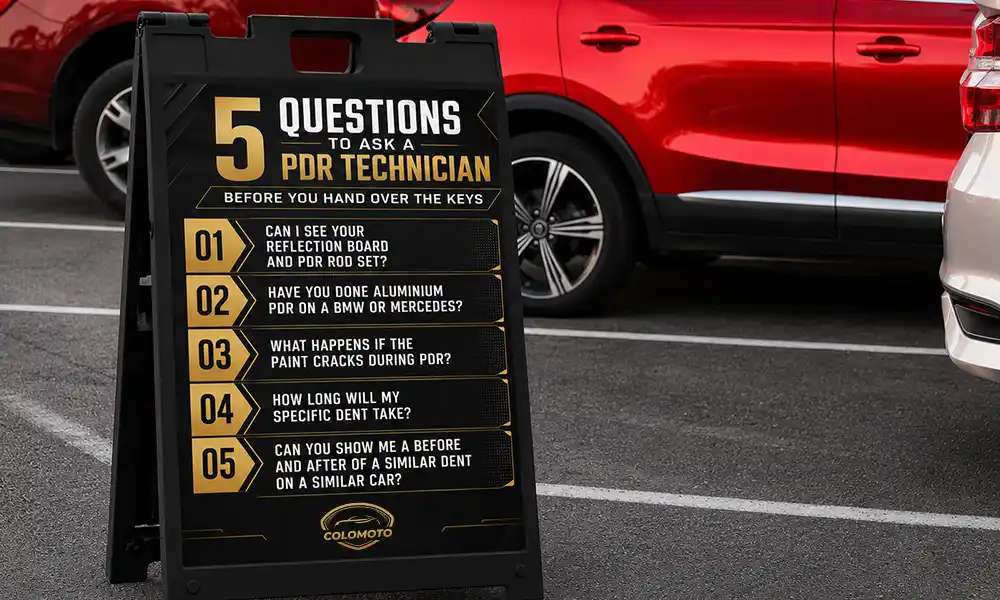
This is the practical closing section. Five questions that separate real PDR studios from amateurs.
Question 1. Can I see your reflection board and PDR rod set
A real PDR studio has these tools visible and will happily walk you through them. A studio that says these tools are with a technician who is out today is not a real PDR studio.
Question 2. Have you done aluminium PDR on a BMW or Mercedes
If your car is aluminium equipped, this question matters. A studio experienced with aluminium will name the specific models they have worked on and will explain the slow multi push approach aluminium requires. A studio that has only done steel will often falsely claim aluminium experience.
Question 3. What happens if the paint cracks during PDR
Honest studios acknowledge this risk and explain their policy. Usually this is a small area paint touch up included in the original quote, or a renegotiation if the area is larger than expected. A studio that claims PDR never causes paint cracks is lying. Paint cracks during PDR occur rarely but they occur, especially on older cars with degraded clear coat.
Question 4. How long will my specific dent take
A real PDR technician can give you a specific time estimate based on the dent dimensions and the panel. A vague "same day" answer usually means the technician has not actually assessed the dent in detail.
Question 5. Can you show me a before and after of a similar dent on a similar car
A real PDR studio has a portfolio of work photographed under natural light. A studio that cannot produce before and after photos is either new to PDR or not confident in their results.
At Colomoto we answer all 5 questions in detail before booking any PDR work. We also walk you through our tool set, show you our before and after portfolio, and explain the specific technique we will use on your dent. If we do not think PDR is the right answer for your dent, we will tell you directly and recommend traditional repair instead.
Visit us at 323, Ahimamau, Sultanpur Road, Lucknow. Call or WhatsApp on +91 7388800192. Email info@colomoto.in.
10. Frequently asked questions
Paintless dent repair is a repair technique where a trained technician restores a dented panel to its original shape using rods pushed from behind the panel or glue tabs pulled from the front, without any sanding, body filler, primer, paint, or clear coat. The factory paint stays completely intact.
Traditional repair strips the paint, works the metal, fills with body filler, sands, primes, paints, and clear coats. PDR works the metal only. Traditional repair replaces factory paint with shop paint. PDR preserves the original factory paint. This difference affects cost, time, resale value, and finish quality.
Yes significantly. PDR typically costs 50 to 70 percent less than traditional repair for the same dent. The cost difference reflects the absence of paint materials, primer, body filler, and the 3 to 4 working days of paint labour that traditional repair requires.
No. PDR works only on dents with intact paint, no sharp creases, accessible panel backs, reasonable size, and materials that respond to PDR pressure. About 40 to 60 percent of all dents in normal Lucknow use qualify for PDR. The remaining 40 to 60 percent need traditional repair.
Yes but with specialised technique. Aluminium requires slow multi push sequences, specific tool tips, and trained technicians. Not every PDR technician has aluminium training. Ask specifically about aluminium experience before booking if your car has aluminium panels.
Simple door ding repairs take 30 to 45 minutes. Moderate dents take 60 to 90 minutes. Larger or more complex dents take 2 to 3 hours. Hail damage covering multiple dents on multiple panels can take a full day. Most PDR work is same day turnaround.
A properly executed PDR repair is invisible under normal viewing. Under a reflection board inspection, a minor halo might be visible at the edge of the repair area which is the trace of the working zone. This halo is not visible in ordinary daylight or indoor lighting.
No. Because PDR does not alter the factory paint or any structural element, it does not affect manufacturer warranty. This is one of the advantages PDR has over traditional repair where the paint warranty may be affected on some brands.
Yes. Hail damage is the classic PDR application. A skilled technician works through dozens of small dents one by one, combining rod pushing on accessible areas with glue pulling on others. Full hail damage repair is usually completed in 1 to 3 days depending on the dent count.
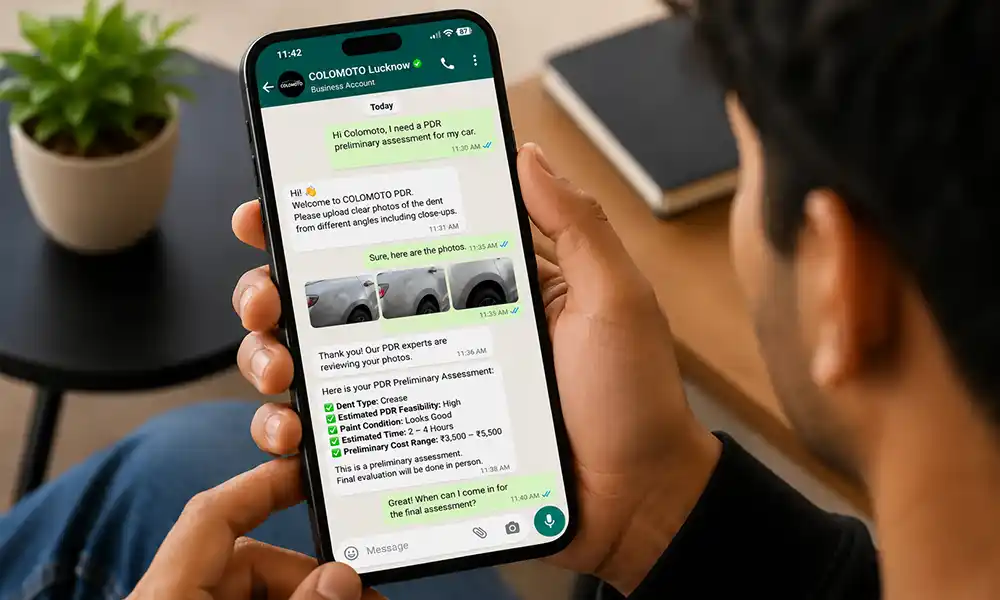
Run your fingernail across the paint over the dent. If the nail catches on any crack or chip, paint is damaged and PDR alone cannot fix it. Look for sharp creases. If present, PDR cannot fully restore. Check the dent size. If larger than 15 cm, PDR is usually not feasible. For certainty, send 4 photos via WhatsApp to +91 7388800192 for a free preliminary assessment.
For hail damage claims yes. For single dent claims under 25,000 rupees, the NCB maths often favours paying out of pocket regardless of PDR or traditional repair. For claims above 40,000 rupees, PDR saves the insurer money and keeps your claim amount smaller which is better for future premiums.
Call or WhatsApp on +91 7388800192. Email info@colomoto.in. Send 4 photos of your dent via WhatsApp for a preliminary qualification assessment. Or visit at 323, Ahimamau, Sultanpur Road, Lucknow any weekday or Saturday between 10 AM and 7 PM for an in person inspection and a free written quote.
Helpful resources
For further reading on paintless dent repair technique and material science, these sources are useful.
Resources We Used
This guide is based on industry-standard PDR knowledge, material science, and real world outcomes from the Lucknow market. Here are some trusted sources if you want to explore further:
- Team-BHP Indian owner experiences with PDR at various studios across cities, for real world outcomes on specific car models.
- Dent Advisor Technical analysis of PDR limitations with material science depth, for understanding the engineering constraints on modern vehicles.
- Sikkens by AkzoNobel Paint system manufacturer whose products are used for the small paint touch ups sometimes needed alongside PDR, for the paint side of hybrid repairs.
Ready for an honest PDR assessment
Send 4 photos of your dent via WhatsApp to +91 7388800192 for a free preliminary qualification check. If your dent qualifies for PDR, we will give you a specific time and cost estimate. If it does not qualify, we will tell you directly and recommend the right traditional repair instead. Visit us at 323, Ahimamau, Sultanpur Road, Lucknow. Email info@colomoto.in.

